Chasing the Sun: Mapping Solar Geometry and Radiation with SunCompass App
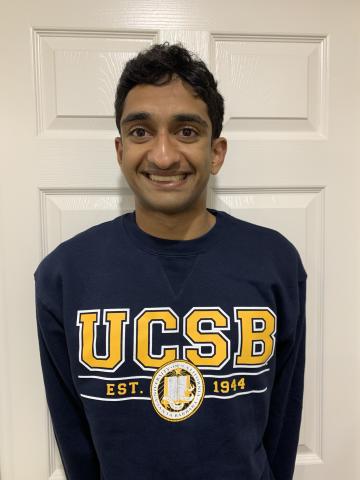
We were particularly proud that Sanjay's work was selected for presentation at the UC GIS event, where it competed alongside submissions from other UC campuses. I attended his presentation, and he delivered an excellent talk showcasing his work —said faculty advisor, Professor Diba Mizra.
Presentation Slides:
https://drive.google.com/file/
UC GIS Week Event Presentations Recording:
https://www.youtube.com/watch?
UCSB Computer Science senior Sanjay Srikanth presented SunCompass, a physically grounded astronomical modeling and visualization tool, at UC GIS Week as part of the GIS Frontiers track. The presentation demonstrated how core computer science principles underpin modern spatial science by enabling precise modeling, scalable computation, and interpretable visualization of geospatial phenomena.
SunCompass was developed as a special project for advanced undergraduate studies under the guidance of Professor Diba Mirza, with an emphasis on translating mathematically rigorous physical models into accessible and reproducible software systems. The project applies numerical methods, geometric reasoning, and careful algorithmic design to compute solar and lunar geometry across geographic locations and time scales. By prioritizing numerical robustness and clear visual representation, SunCompass allows users to explore spatial and temporal relationships with both scientific accuracy and conceptual clarity. During the GIS Frontiers presentation, Srikanth discussed how physically based modeling and precise numerical computation are essential for reliable geospatial analysis, particularly in domains where small numerical errors can propagate into large spatial or temporal inaccuracies.
The presentation situated SunCompass within a broader interdisciplinary context, highlighting computer science as a critical enabling layer for spatial science and GIS. Concepts such as coordinate transformations, floating-point error management, algorithmic efficiency, and data representation were shown to be central to converting raw mathematical formulations into dependable spatial tools. By bridging computer science and spatial science, the project illustrates how advances in computation directly enhance the fidelity, scalability, and interpretability of spatial analysis workflows used in environmental science, mapping, and geospatial decision-making, while also establishing a reliable systems-level foundation for downstream data-driven and AI-enabled applications such as solar forecasting, site suitability analysis, and automated spatial modeling.
SunCompass was previously recognized with the Best Scientific Component award at the CodersSB/ACM showcase in May 2024 for an earlier proof-of-concept prototype, reflecting its strong computational foundation and integration of mathematics and visualization. Building on this foundation, the UC GIS Week presentation emphasized the project’s continued evolution toward real-world relevance and public-facing scientific communication, aligning with the goals of the GIS Frontiers track to highlight innovative work at the intersection of geospatial research and applied computing.
This presentation reflects ongoing undergraduate research and public scholarship within the UCSB Computer Science community, highlighting the value of faculty-guided special projects and interdisciplinary computing in advancing spatial analysis and data-driven understanding of the physical world.