Student Teams Tackle Real-World Problems at Annual CS Capstone Day

“There is not going to be a better opportunity to really dig into a specific project andsee it to fruition.” That is how fourth-year computer science student Cooper Hawley describes the UC Santa Barbara Department of Computer Science's two-quarter industry-partnered capstone sequence. This past March, his cohort demonstrated exactly that, presenting production-ready software systems to an audience of faculty, alumni, and industry partners at the department's annual Capstone Day.
The work produced this year was not course work in the traditional sense. “Students are no longer just coding,” said Capstone Instructor Chandra Krintz, Professor of Computer Science and Associate Dean of the UCSB Graduate Division, who taught the winter-quarter course. “They are acting as systems architects, integrating complex distributed agents, leveraging recent advances in artificial intelligence and machine learning, and incorporating advanced cloud services.”
The forty students had spent two quarters getting there: forming teams in the fall, selecting projects pitched by sponsors AppFolio, Artera, Cadense, Cottage Health, Mysten Labs, Planet Labs, SpaceComputer, and Visual Layer, and building toward March under the instruction of Professor of Computer Science Dahlia Malkhi in the fall quarter and Krintz in the winter. The judging panel comprised Chris Bunch of Google, Wei-Tsung Lin of Salesforce, and Alexis Cole of Amazon.
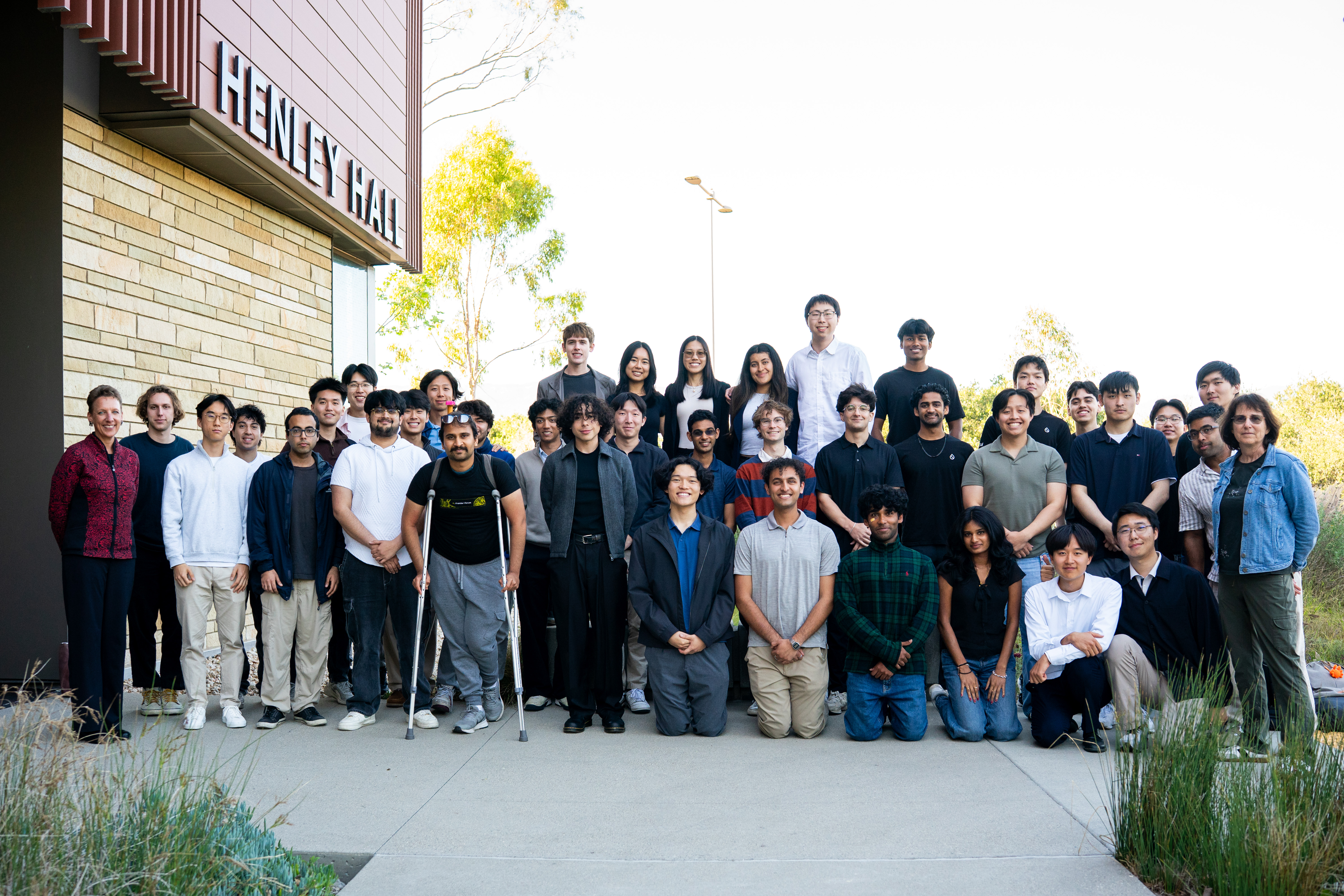
Image Above Group photo of the 2026 Student Cohort for the Computer Science Capstone with CS Professors Chandra Krintz and Dahlia Malkhi and Teaching Assistant Rithwik Kerur, next to Henley Hall.
Award Winners
First place went to Team Altera for a system that addresses one of healthcare's most persistent inefficiencies: referral coordination. Working with sponsor Artera, the team (fourth-year computer science student Cooper Hawley and fourth-year computer engineering students Aden Jo, Benjamin Soo, David Duenas, and John Hagedorn) built an AI-agent pipeline that compresses a process that typically takes several days into one that patients can complete in under an hour. Physician oversight is preserved at every stage.
Second place went to Team Cadense for a home rehabilitation system designed for stroke survivors. Fourth-year computer engineering students Vincent Cheong, Jim Wang, Christopher Lai, Scott Ricardo Figueroa-Weston, and Jeremiah Wong developed a wearable device and companion smartwatch app that delivers synchronized visual, audio, and haptic cues to help patients maintain correct movement cadence outside of clinical settings. Iterative testing with actual patients reshaped the final design entirely, producing an interface built around the needs of older users with physical impairments. “Now I know it is important to talk to your users as soon as possible,” Figueroa-Weston said.
Third place went to Team RapidRecall, sponsored by Cottage Health, for a platform that automates the analysis of FDA and industry supplier recalls. The system is designed to close a critical window: the gap between a recall being issued and a hospital acting on it, during which harmful medical devices and pharmaceuticals can still reach patients.
What Happens Next
The capstone program has a consistent record of producing work that outlasts the course. Three of last year’s eight projects reached some form of deployment after graduation, including one team that formed a startup subsequently funded by the City of Santa Barbara’s incubation program. Several students from the current cohort have already been admitted to continue their projects as graduate researchers in Mahlki's lab.
The effects on careers are direct. “Some of the students get jobs from the companies they have interacted with. Some get jobs from the judges or spectators that came to the capstone event,” Malkhi said. “All the students that come back to talk with me say that in their job interviews, they have a story to tell beyond their transcripts. They tell me that this is the one thing that gets them job offers.”
The judges, for their part, keep coming back. “The judges have repeatedly told us: this is the best day of our year,” Malkhi noted. “And these are senior people in the industry who see a lot of cool things.”